What is visual merchandising? It is the practice of arranging products, displays, lighting and store layout so shoppers notice, enjoy and buy. Every window, mannequin and rack you walk past in a fashion store was planned by someone. You can learn this skill in our Diploma in Fashion & Retail Management, part of the School of Fashion at India Learns, Kochi, which includes a full module on visual merchandising and store performance.
This guide explains the meaning of visual merchandising, its types and elements, common store layouts, what visual merchandisers earn in India and how to start a career.
In short
- Meaning: visual merchandising (VM) is how a store presents products to attract shoppers and increase sales.
- Two types: exterior (windows, signage, storefront) and interior (layout, displays, mannequins, lighting).
- Pay in India: self-reported ranges run from about ₹1.6 lakh for early-career roles to ₹11 lakh a year for experienced area-level roles.
- Entry point: retail associate or visual merchandising assistant, then visual merchandiser or store manager.
- No degree needed: a focused diploma with practical projects is a common starting route.
What is visual merchandising?
Visual merchandising is the planning and styling of a store’s look so products are easy to find, attractive to look at and linked to the brand’s image. It covers everything a shopper sees: window displays, signage, store layout, shelves and racks, mannequins, colours and lighting.
The goal is simple. A good display makes a person stop, walk in, pick something up and, ideally, buy it.
What is the full form of VM in retail?
In retail, VM stands for visual merchandising. You will see it in job titles such as VM executive, VM assistant and area visual merchandiser. It is different from fashion merchandising, which is explained in the FAQs below.
Why does visual merchandising matter in fashion retail?
In fashion, shoppers decide quickly and by eye. Visual merchandising helps them see how pieces work together, steers them through the store and tells the brand’s story without a word. It also gives stores a way to refresh the look for every season, festival and sale.
The business case is growing. CareEdge Ratings estimates India’s apparel retail market at ₹9.30 lakh crore in 2024-25 and expects it to reach nearly ₹16 lakh crore by 2029-30. More retail means more stores, and more stores need people who can plan displays.

People are searching for this topic too. In India, “visual merchandising” gets an estimated 2,500 searches a month, “visual merchandising meaning” about 1,000 and “planogram” about 1,900.

What are the types of visual merchandising?
There are two main types: exterior and interior. Exterior visual merchandising attracts people from the street. Interior visual merchandising guides them once they are inside.
| Type | What it covers | Examples in a fashion store |
|---|---|---|
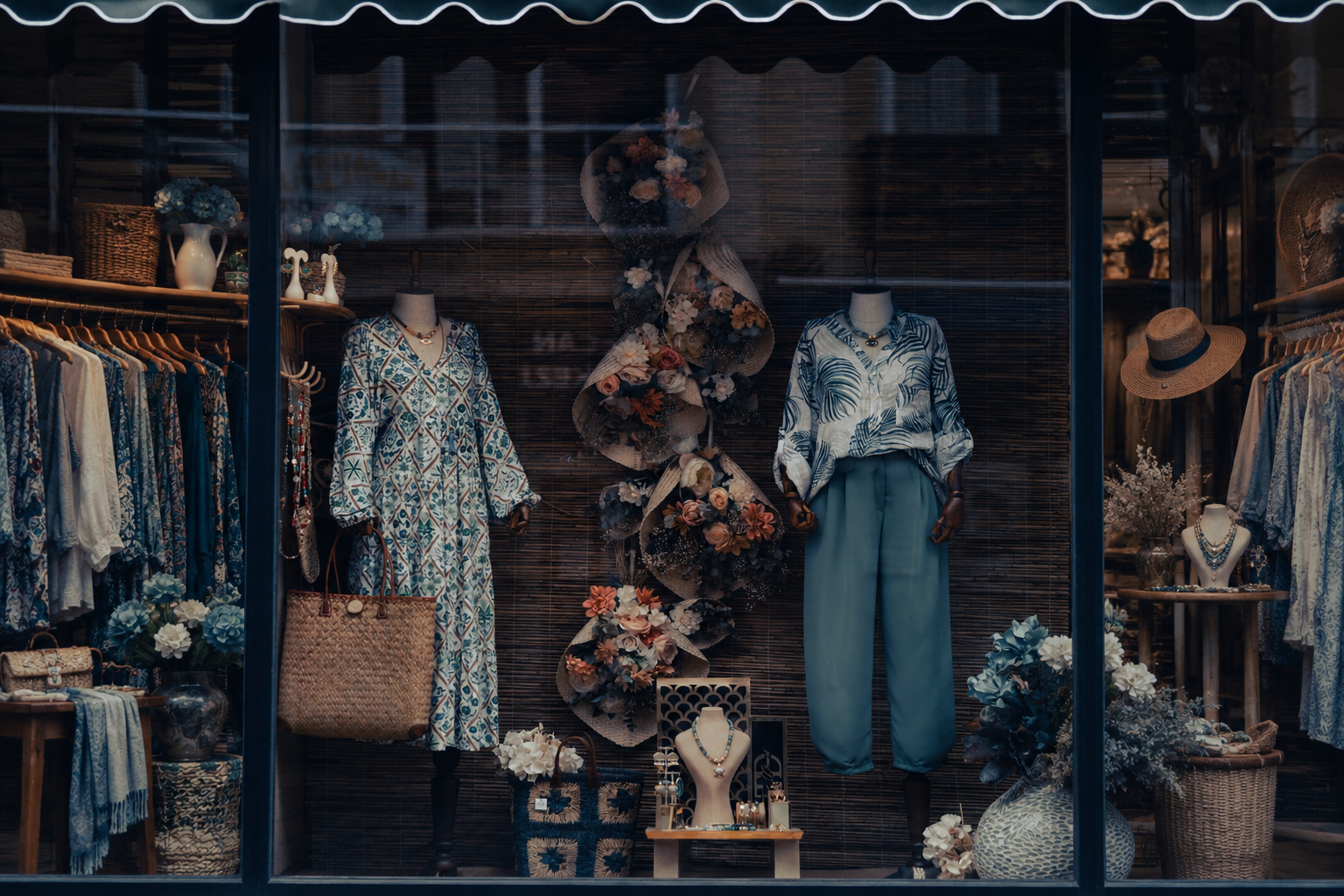
| Exterior | Everything a passer-by sees before entering | Window displays, outdoor signage, banners, storefront lighting |
| Interior | Everything inside the store | Store layout, mannequins, racks and shelves, point-of-purchase displays, colour grouping, lighting |
What are the main elements of visual merchandising?
Six elements do most of the work. A visual merchandiser balances them so the store looks consistent and easy to shop.
| Element | What it does | Fashion store example |
|---|---|---|
| Colour | Sets the mood and groups products | A rack arranged by shade from light to dark |
| Lighting | Directs the eye to key pieces | Spotlight on a new-arrival wall |
| Space and layout | Controls how shoppers move | A wide aisle leading to the trial rooms |
| Mannequins and props | Show how clothes are worn together | A complete outfit with bag and shoes |
| Signage and graphics | Communicates offers and the brand story | A festive sale banner at the entrance |
| Product placement | Puts the right products where shoppers look first | Bestsellers at eye level near the entrance |
Five principles guide how these elements are arranged. They are commonly taught as:
- Balance: weight and colour are spread evenly so the display feels steady.
- Emphasis: one clear focal point pulls the eye first.
- Contrast: differences in colour, size or texture make key items stand out.
- Repetition: repeated shapes or colours create rhythm and unity.
- Proportion: items are scaled so the display feels natural and uncluttered.
What are the common store layouts?
Store layout decides the path a shopper takes. Planners often sketch it as a floor plan, and use a planogram, a diagram that shows exactly where each product sits on a rack or shelf.
| Layout | How it works | Best suited to |
|---|---|---|
| Grid | Straight aisles with racks in rows | Large stores with many product lines and quick browsing |
| Loop (racetrack) | A main path loops past every zone of the store | Department stores and large fashion floors |
| Free-flow | No fixed path, displays arranged in clusters | Boutiques and premium stores |
What does a visual merchandiser do?
A visual merchandiser plans how a store looks and checks that it keeps working. Typical tasks include:
- Planning window and in-store displays for each season, launch and sale.
- Dressing mannequins and styling props, signage and lighting.
- Following brand guidelines and planograms across every store.
- Reviewing sales and footfall to see which displays work, then adjusting them.
- Working with buyers, store teams and suppliers so stock and displays match.
How much does a visual merchandiser earn in India?
Pay depends on experience, brand and city. AmbitionBox, which collects self-reported salaries, shows the ranges below. Treat them as a guide, since some samples are small.
| Role | Reported salary range (per year) | Note |
|---|---|---|
| Visual merchandiser, 2 to 6 years | ₹1.6 lakh to ₹3.8 lakh | Based on 9 salaries |
| Area visual merchandiser, Ernakulam | ₹3 lakh to ₹7 lakh | Based on 6 salaries, low confidence |
| Area visual merchandiser, 3 to 11 years, major metros | ₹3.1 lakh to ₹11.4 lakh | Across Mumbai, Bengaluru, Pune, Delhi and Chennai |

The jump from the first row to the third shows the pattern: pay rises as you move from a single store to managing displays across several stores.
What skills does a visual merchandiser need?
| Skill | Why it matters | How to practise |
|---|---|---|
| Colour and composition | Makes displays look balanced and on brand | Redo one shop window layout three ways |
| Spatial planning | Helps shoppers move easily and see more products | Sketch a floor plan of a store you visit |
| Trend awareness | Keeps displays current each season | Track runway, street style and festive campaigns |
| Retail numbers | Links displays to sales and stock | Learn footfall, conversion and sell-through |
| Brand consistency | Keeps every store looking the same | Write a one-page display guide for a brand |
| Tools | Used for mood boards, layouts and presentations | Practise in Canva, Photoshop and PowerPoint |
How do you become a visual merchandiser?
- Learn the basics. Study colour, layout, retail operations and how customers behave in stores.
- Take a structured course. A diploma that combines retail operations with visual merchandising gives you practice, not just theory.
- Practise on real spaces. Redesign a shop window or rack with permission, and photograph it before and after.
- Build a portfolio. Include before-and-after photos, floor plans, mood boards and a short note on what changed.
- Start in a store role. Retail associate or visual merchandising assistant roles teach you how stores really run.
- Grow into the role. Move to visual merchandiser, area visual merchandiser or store manager as you gain experience.
You do not need a degree to begin. Employers look at your portfolio, your eye for detail and how well you understand retail.
What will you learn in the Diploma in Fashion & Retail Management at India Learns?
The Diploma in Fashion & Retail Management is a 12-month blended programme in Kochi. It asks for 10+2 or equivalent, age 18 or above, and no prior experience. One of its eight modules is Visual Merchandising & Store Performance, and the rest build the retail and fashion skills around it.
| Area | What you cover |
|---|---|
| Visual merchandising | Visual merchandising and store layout planning, with a dedicated module on store performance |
| Retail operations | Retail operations and compliance, POS systems, stock control and sales analytics |
| Customer skills | Customer service, consultative selling and customer experience |
| Fashion and brand | Trend research, consumer behaviour, brand positioning, textiles, colour and sourcing |
| Portfolio | A professional portfolio built from day one, plus a final project |
| Roles it points to | Visual merchandising assistant, fashion retail associate, retail operations assistant, then visual merchandiser, store manager or buyer |
Interested in a styling-led path instead? Explore the Certificate Course in Fashion Styling & Image Consulting or the Diploma in Digital Fashion & Entrepreneurship. To see what each path leads to, read Career Options After a Fashion Design Diploma. Ready to apply? Visit the admission page or contact the team for current fee and batch details.
Your next step
Pick a shop you know and sketch its floor plan, then redesign one window on paper. If you want guided practice and a portfolio, see the Diploma in Fashion & Retail Management or call the admissions team on +91 9249 551 757.
FAQs
What are the two types of visual merchandising?
The two types are exterior and interior visual merchandising. Exterior covers what people see from the street, such as window displays and signage. Interior covers what shoppers see inside, such as layout, mannequins, racks, lighting and in-store displays.
What are the 5 principles of visual merchandising?
Five commonly taught principles are balance, emphasis, contrast, repetition and proportion. Together they decide where the eye goes first, how products group together and whether a display feels organised or cluttered.
What are the 5 qualities of a merchandiser?
Commonly listed qualities are creativity, attention to detail, an eye for trends, comfort with sales numbers and clear communication. Merchandisers use them to plan displays, stock and promotions that match what customers want.
What is the difference between visual merchandising and fashion merchandising?
Visual merchandising is about how products look and where they sit in the store. Fashion merchandising is about what to buy and stock, how to price it and how much of each style to order. Both aim to increase sales, and many retail roles use both.
Is visual merchandising a good career?
It suits creative people who like retail. Entry roles pay modestly, with self-reported ranges from about ₹1.6 lakh a year, but experienced area-level roles are reported up to about ₹11 lakh. Growth depends on your portfolio and results.
Do I need a degree to become a visual merchandiser?
No degree is strictly required. Employers look at your portfolio, practical skills and retail understanding. A diploma with hands-on projects, such as the India Learns Diploma in Fashion & Retail Management, is a common way to start.